
Rooted in Tradition
KENILWORTH, N.J. –– It began beneath a tree.
On September 14, 1926, John Anderson, the golf course superintendent at Crestmont Country Club, invited a small group of neighboring greenkeepers to gather beside the maintenance barn. Similar organizations had begun taking shape in Philadelphia and Ohio, and conversations about establishing a national association were underway. Anderson believed New Jersey's greenkeepers deserved a place to call their own.
There was no grand ceremony. No elaborate agenda. Just a group of men who understood the demands of their profession and recognized the value of facing them together.
The following April, the group convened at a hotel in Newark, establishing bylaws and formally organizing what would become the Golf Course Superintendents Association of New Jersey (GCSANJ).
A century later, the organization has grown from a few dozen members paying five dollars in annual dues to a network of more than 500 professionals. Equipment has evolved, scientific understanding has advanced, and the expectations placed on golf course superintendents have grown considerably.
Yet the principles that brought those first greenkeepers together remain remarkably unchanged.
"The whole purpose of the association was just to form camaraderie with superintendents and to tackle the issues that the industry was facing at the time," said Maureen Sharples, executive director of GCSANJ. "I find that really interesting because it's really the same purpose 100 years later."
Among the association's founding clubs were Mountain Ridge Country Club, The Ridgewood Country Club, Plainfield Country Club, Echo Lake Country Club, Crestmont Country Club, Essex Fells Country Club and Essex County Country Club, names that remain closely connected to New Jersey's golfing identity.
Through the Great Depression, periods of rapid growth, environmental challenges and the uncertainty of the COVID-19 pandemic, the association has provided a place for superintendents to exchange ideas, find solutions and support one another.
While the challenges facing the profession have changed over the decades, the value of that shared experience has endured. What began as a gathering of neighboring greenkeepers has become a statewide community, connected by the responsibility of caring for the courses that define golf in New Jersey.
The Work Behind the Game
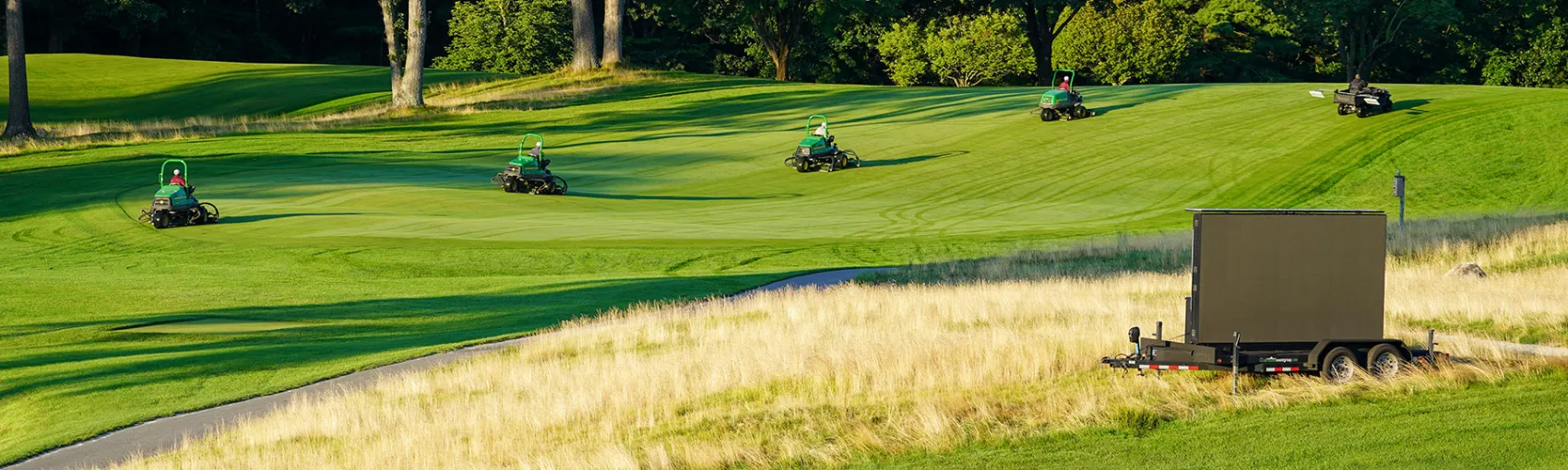
For most golfers, the work of a superintendent is measured in the moments they rarely see.
It happens long before the first tee time, when the course is still quiet and the day's preparations are already underway. It continues through changing weather, unpredictable growing conditions and the constant demands of maintaining acres of living turf.
The finished product is familiar: fairways cut cleanly, greens rolling smoothly and a golf course ready to welcome its next group of players.
What goes into creating that experience is considerably more complex.
Sharples understands that distinction better than most. The daughter of a superintendent, she grew up at Preakness Hills Country Club, where she witnessed firsthand the dedication required to care for a golf course.
Today, working alongside the professionals who carry on that responsibility, she sees something beyond the science and maintenance.
"I think there's a lot of personal connection superintendents have with the game of golf and with the land," Sharples added.
For her, the profession is about more than providing excellent playing conditions. Superintendents understand that golf courses serve as the backdrop for meaningful moments, from family traditions and friendships to professional relationships and personal milestones.
"They know that by creating excellent playing conditions, by caring for the land, by being stewards of the environment, that they're gifting an experience to every golfer every round," she said.
That responsibility extends from the everyday round to some of the game's grandest stages.
New Jersey has long been home to nationally recognized championship venues, including Baltusrol, Plainfield and Ridgewood. Each has welcomed generations of competitors, with the conditions of the golf course playing an integral role in the championship experience.
Long before the first competitive shot is struck, superintendents and their maintenance teams are at work preparing for the demands of tournament golf. Their responsibilities extend well beyond the days of competition, requiring careful planning, attention to detail and an understanding of how the course will respond to changing conditions.
For New Jersey Golf, that work is an essential part of conducting championships throughout the state. From local qualifiers to state championships, the partnership between tournament organizers, host clubs and maintenance teams helps create an environment where competitors can perform at their best.
The contributions of those working behind the scenes may not appear on a leaderboard or in the final results, but their influence can be felt with every shot.
And whether preparing a course for a major championship or a regular Saturday morning, the commitment to the playing experience remains much the same.
Growing Together
The profession has always demanded a willingness to adapt.
Over the past century, superintendents have navigated turf diseases, water concerns, financial uncertainty and an evolving understanding of environmental responsibility. What once depended heavily on experience and observation is now supported by increasingly sophisticated research and technology.
Autonomous mowers, drones and advanced irrigation systems are changing how golf courses are maintained, helping superintendents make more informed decisions while improving efficiency and conserving resources.
"All of that knowledge and data that technology has given us has allowed superintendents to change their agronomic plan and tailor it to their particular solutions, their particular situation," Sharples said.
Yet as the tools available to superintendents become more advanced, the importance of learning from one another has not diminished.
A challenge at one course may already have been solved at another. An unfamiliar turf condition may be something a colleague has encountered before. And sometimes, the most valuable resource is simply having someone who understands the demands of the job.
It is a collaborative approach that has defined GCSANJ since its earliest days.
Rather than working in isolation, superintendents have the opportunity to draw on the collective knowledge of professionals throughout the state, sharing experiences and practical solutions that can benefit courses far beyond their own.
GCSANJ encourages those connections through its three geographic districts, educational opportunities and gatherings that bring members together away from their courses.
That collaborative spirit also extends to the association's longstanding relationship with Rutgers University, where turfgrass research and educational programs have helped develop generations of industry professionals.
Through Rutgers' turf management education, aspiring superintendents can combine classroom instruction with practical experience, building the foundation for careers in the industry while developing connections throughout New Jersey.
Together, those educational opportunities and professional relationships have helped create a community in which knowledge is passed from one generation to the next.
The result is a profession that continues to evolve without losing sight of the shared purpose that brought its earliest members together.
The Next Hundred Years
As GCSANJ celebrates its centennial, the conversation is not limited to what the association has accomplished. Increasingly, it is about who will carry its mission forward.
Attracting young people to the profession remains one of the industry's most significant challenges.
Early mornings, demanding schedules and the unpredictability of working outdoors are realities of the job. But the profession also offers an opportunity to combine science, technology, environmental stewardship and a love of the outdoors.
Introducing that opportunity to the next generation has become an important part of the association's work.
In recent years, GCSANJ has embraced the First Green program, which transforms golf courses into outdoor STEM classrooms for students and youth organizations.
Through hands-on field trips, young people discover that the course they may know as a place to play is also a place to explore soil science, plant biology, water management and environmental sustainability.
The association has also strengthened its connections with organizations such as 4-H and Future Farmers of America, introducing students with interests in agriculture and plant sciences to careers they may never have considered.
These efforts reflect a broader shift in how the profession is presented to young people. Golf course maintenance is no longer defined solely by the traditional image of mowing fairways and tending greens. Today's superintendents draw on a wide range of skills, from agronomy and environmental science to data analysis, technology and leadership.
As technology continues to evolve, so too will the opportunities available to those entering the industry. But developing the next generation will require more than introducing new tools or techniques. It will require the same commitment to mentorship, education and collaboration that has sustained the association for a century.
For GCSANJ, the task ahead is to ensure that the knowledge accumulated over the past 100 years continues to reach those who will care for New Jersey's golf courses in the decades to come.
One hundred years ago, a handful of greenkeepers gathered beneath a tree because they believed their profession would be stronger together.
They could hardly have imagined the technology, challenges or opportunities that would shape the century ahead. But they understood something fundamental about their work: that caring for a golf course requires knowledge, dedication and a community willing to share both.
The tools have changed. The profession has grown. The courses themselves have evolved.
And as the Golf Course Superintendents Association of New Jersey enters its second century, the foundation established that September afternoon remains firmly in place.
"I think that's a blueprint we shouldn't change," Sharples said.
NJ Golf Social Media
For the latest updates and news, visit njgolf.org or follow New Jersey Golf on Facebook, X and Instagram at @njgolf1900.


