
“One Great Big Sand Trap”: 55 Years of the Moon Club
By Elizabeth Beeck, Exhibitions Curator at the USGA Golf Museum and World Golf Hall of Fame
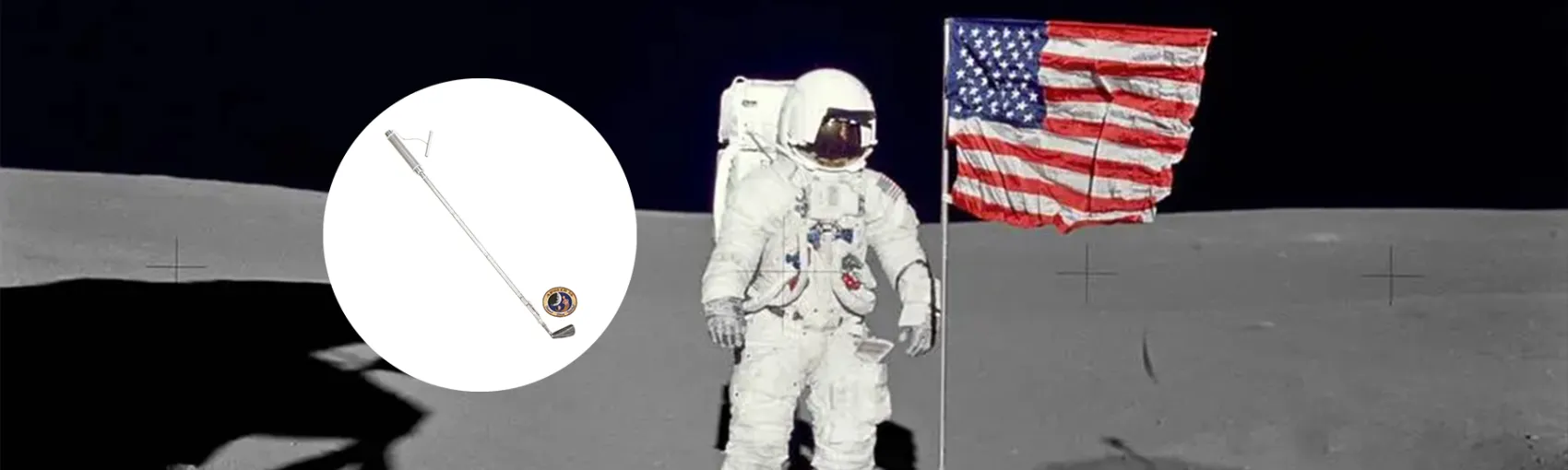
On February 6, 1971, Rear Admiral Alan B. Shepard Jr. closed out his moonwalk with one of the most famous golf shots of all time. Shepard, an avid golfer, hit two balls using his makeshift Wilson Staff 6-iron to demonstrate the gravitational pull of the Moon. The second attempt, which he claimed went for “miles and miles and miles,” traveled six times farther than it would have on Earth.
Shepard was the commander of the Apollo 14 mission to the Moon which launched on January 31, 1971. He traveled to space with Edgar D. Mitchell, the lunar module pilot, and Stuart A. Roosa, the command module pilot. The mission’s primary objective was to explore the Fra Mauro region on the moon, conduct a variety of scientific experiences, and photograph the moon’s surface. The crew conducted two lunar surface excursions lasting nine hours total and collected 93 pounds of lunar samples.

Shepard broached the idea of hitting a golf ball on the Moon to Bob Gilruth, the director of NASA’s Manned Spacecraft Center, who needed some convincing. Shepard assured Gilruth that he would cover the cost of the club and balls and that he would only take a swing at the end of the successful mission.
Shepard worked with Houston-area golf professional Jack Harden to attach the modified clubhead to a tool used to collect lunar rock samples, which was approximately the length of a 6-iron shaft. The club and two balls traveled to the Moon in one of Shepard’s tube socks and history was made.

transport it and the two balls to the Moon. (Copyright USGA/John Mummert)
|

|
Shepard donated the club to the USGA at the 1974 U.S. Open at Winged Foot G.C. in Mamaroneck, N.Y., and it remains on display at the USGA Golf Museum and Library in Liberty Corner, N.J. A replica of the club and Shepard’s tube sock are showcased at the World Golf Hall of Fame in Pinehurst, N.C. This club is proof that one’s love of golf truly has no earthly limits.
Located at the USGA's headquarters in Liberty Corner, N.J., the USGA Golf Museum and Library is the nation's oldest sports museum and the world's leading institution for the collection, preservation, interpretation and dissemination of golf history. To learn more, visit usga.org.